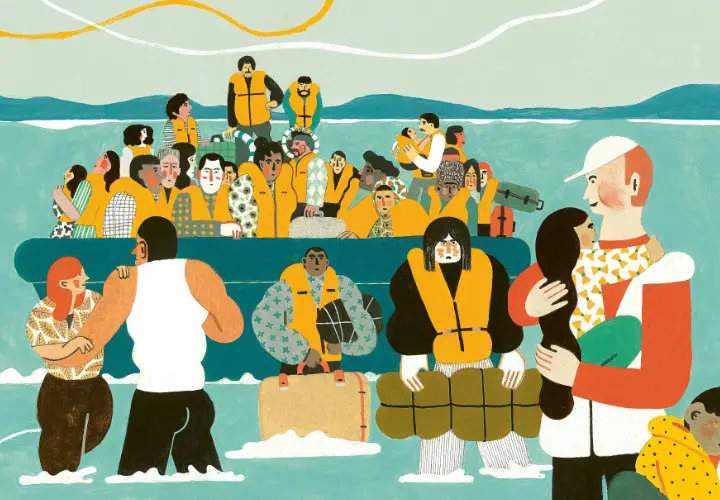
How we respond to conflict, migration and refugees is an on-going subject at both a political and personal sphere. In this article we revisit the ‘why’ and the ‘how’ we address this issue in our education settings.
In April the Rwanda deportation bill become law. A ‘plan to stop the boats’ which is devoid of compassion and humanity. In June it is Refugee Week with the theme of ‘Our Home’. People are being asked to extend their warmth and hospitality beyond their homes welcoming in new neighbours. The contrast is stark.
“As educators we need to provide children and young people with the tools to navigate these increasingly polarised views of issues”
As educators we need to provide children and young people with the tools to navigate these increasingly polarised views of issues, such as immigration, and enabling them to recognise when facts have been distorted or wilfully misused to score points in an argument rather than provide accurate information. To ask different questions such as why are people risking everything to reach the UK in a small, unseaworthy boat? What are the root causes of these global movements of people? While the answers are complex and mired in historic injustices, learners in Scotland can be provided with the tools they need to better understand complex global issues and decide for themselves the kind of Scotland they want to live in.
Fact or fiction?
Right now, 1% cent of the world’s population – or one in 97 people – has been forced to flee their homes according to the UN Refugee Agency (2022). This has nearly doubled compared to ten years ago, and 40% of this group are children. The majority of displaced people, 85%, now live in countries in the global south. 73% are in neighbouring countries or places close to the country they have fled. The actual number of asylum seekers arriving in the UK are relatively small.
“Developing critical literacy is a key skill in Global Citizenship and a necessary one for interpreting the way the media is shaping and directing the narrative of this issue.”
A good place to find accurate statistical information about refugees and asylum seekers is the British Red Cross. They also provide some excellent teaching materials around issues of migration.
Critical literacy
Developing critical literacy is a key skill in Global Citizenship and a necessary one for interpreting the way the media is shaping and directing the narrative of this issue. Much of the language used to describe refugees, migrants and asylum seekers is negative and lacks objectivity. Examining headlines and unpacking the language used to describe this issue is a useful way of separating the facts from opinions but also reflecting on the values which underpin these views. ‘As ithers see us’ from the resource A’ Adam’s Bairns? is a good starting point to begin to look at the language, focusing on how people from the UK have been viewed by others.
Curriculum links
There are many opportunities within the curriculum at all levels for exploring the themes of migration. Scarce resources, climate change and lack of access to basic needs remain key drivers of conflict and fuel on-going movements of displaced people and refugees. Specific topics on migration are taught within social subjects itself including population, migration patterns and historical comparisons to WWII refugee crisis. Scotdec have produced resources which use migration as a learning context for Maths, English and Modern Languages.
“It is about teaching for compassion, kindness and empathy while providing accurate information and dispelling myths.”
Values
Fundamentally this is about exploring what it means to be human. It is about our values and those of other people. It is about challenging the attitudes which are dominant in some parts of the media. It is about teaching for compassion, kindness and empathy while providing accurate information and dispelling myths. Fundamentally, it is about enabling children and young people to decide for themselves their views on an issue which none of us should look away from.
I Have the Right by Reza Dalvand is published in the UK by Scribble Kids Books